Cracked Open: The Very British Ritual of the Takeaway Fortune Cookie
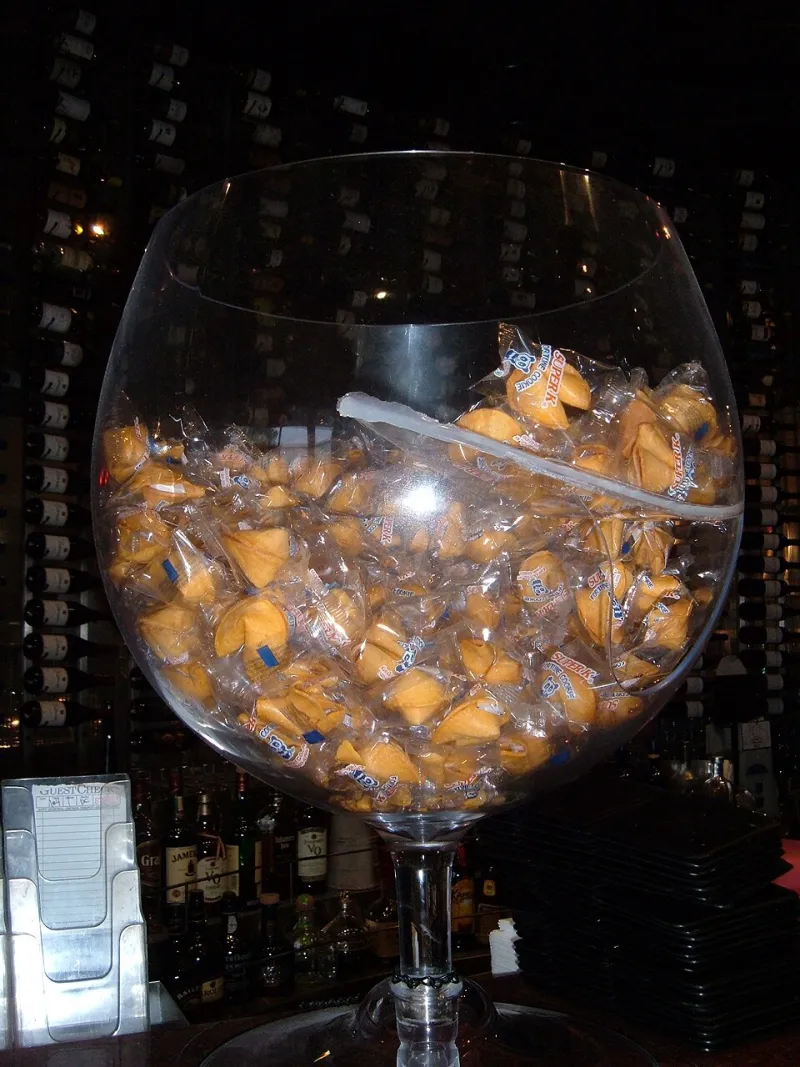
Photo: BrokenSphere, CC BY-SA 3.0, via Wikimedia Commons
There it is again. Down at the bottom of the bag, wedged somewhere between the spare soy sachets and the receipt nobody asked for: a small plastic-wrapped biscuit with a paper slip inside. You didn't order it. You'd complain if it wasn't there.
It is, by any reasonable measure, the strangest freebie in British food. Not a mint. Not a chocolate. A dry, pale, faintly vanilla disc that makes a noise somewhere between a snap and a snap of disappointment — and which has somehow become the full stop at the end of the great British Chinese takeaway.
So how did it get here, and why do we all still play along?
The biscuit with no Chinese address
Let's get the awkward bit out of the way first: the fortune cookie is not Chinese. It isn't sold on street corners in Beijing, it doesn't appear at banquet tables in Guangzhou, and if you handed one to a relative in Chengdu they'd look at you as though you'd passed them a coaster.
The biscuit's actual origins sit in Japan, where folded, fortune-bearing senbei-style crackers have been documented for well over a century. The version we'd recognise today took shape in California. Credit is usually shared between Makoto Hagiwara, who is said to have served them at the Japanese Tea Garden in San Francisco's Golden Gate Park in the 1910s, and Seiichi Kito, a Los Angeles confectioner who claimed a similar invention around the same period. From there, the biscuit drifted into the city's Chinatown, where it was made in bulk, sold to restaurants and eventually exported as an idea.
The second world war helped things along. Chinese-American restaurateurs picked up the habit and used the cookies as a small, sweet gesture for servicemen and customers, and by the middle of the century the fortune cookie had become, in the eyes of most of the world, indelibly Chinese. Which is a lovely irony: a Japanese biscuit, made famous by Chinese restaurants, in America.
Then it crossed the Atlantic. And then the Irish Sea
Britain met the fortune cookie later, and through two doors at once. One was the growing American influence on restaurant culture in the post-war decades; the other was Chinatown itself, particularly in Liverpool and London, where imported novelties sat alongside the more established larder of beansprouts and bamboo shoots.
By the 1980s and 90s, the free biscuit had become a standard part of the suburban takeaway bag. It was cheap, it was cheerful, it gave the order a sense of occasion, and — crucially — it kept children quiet for four whole minutes. In Ireland it took hold just as firmly, and the ritual of reading the slip aloud migrated across the water with it.
What's interesting is how badly the biscuit fits the food. A takeaway is hot, wet, salty and immediate. The cookie is dry, sweet, patient, and kept for last. It's the only part of the meal you deliberately delay.
The reading-aloud ritual
Nobody instructs you to read the fortune out. You just do. There's a choreography to it. The bag is cleared, the plates are pushed away, someone finds the biscuit under a stray chip, and the crack is the signal for attention.
The rules, as observed in households across the UK:
- The youngest person present breaks theirs first, and reads it with the seriousness of a passport stamp.
- Everyone else gets one turn. No swapping. No asking for a better one.
- Fortunes are read aloud, always, even when they're gibberish.
- The phrase "in bed" is appended to the end by at least one person, every single time, and it's funny every single time.
- Someone announces their lottery numbers with total conviction, and someone else points out they haven't bought a ticket in three years.
It's a tiny piece of theatre, and it's the same in a student flat in Sheffield as it is at a family table in Cardiff — a shared, slightly silly full stop that no one designed and nobody enforces.
The crunch nobody admits to liking
The flavour is essentially "biscuit". Vanilla, sugar, a hint of something toasty, and — if the bag's been sitting under a hot chow mein for twenty minutes — a texture somewhere between crisp and forgiving.
And yet. Hand a room of adults a plain biscuit and a plain biscuit alone, and it'll sit there. Wrap it in plastic with a scrap of paper that tells you a journey of a thousand miles begins with a single step, and suddenly it's a treat. The fortune is doing all the work. The cookie is a delivery mechanism.
There's something quietly British about that arrangement: a modest, slightly stale vehicle for a small bit of ceremony. We do this with crackers, with Christmas pudding, with the entire concept of a packet of digestives. Give us something plain and a reason to be a bit sentimental and we're away.
2026: the slip goes digital
Here's where it gets interesting. A number of takeaways have been quietly swapping the paper slip for a QR code — sometimes printed on the wrapper, sometimes on a little card tucked into the bag alongside the crackers. Scan it and you don't just get your fortune. You get a horoscope. A discount code for your next order. A link asking you to leave a Google review. A whole little branded universe.
Some of it is charming. Some of it is a menu upsell wearing a fortune cookie's coat. But the direction of travel is clear: the biscuit is becoming a channel, and the fortune is becoming content.
The traditionalists among us would argue that a fortune you have to peer at through a phone screen lacks a certain something. The ritual, after all, isn't really about the message. It's about the crack, the pause, the reading out. A push notification can't quite replicate that.
A field ranking of the fortunes you'll actually get
Having consulted the bag ends of the nation, here's the honest hierarchy, from worst to best.
5. The vaguely threatening one. "Beware of people who offer you something for nothing." Sir, this is a takeaway. Everything here has been paid for.
4. The fortune that's just a lottery number. Six digits, no sentence, no wisdom. A lottery ticket with extra steps and none of the winning.
3. The vague compliment. "You have a natural ability to lead." This has never once been true and yet it gets read aloud as though it's a references letter.
2. The cryptic warning. "A closed door opens another." Beautifully ominous. Slightly unsettling on a Tuesday. Excellent material for a bit of domestic paranoia.
1. The one that isn't a fortune at all. Two words. "Think carefully." Nobody knows what to do with it. It hangs over the table like smoke. Ten out of ten, no notes.
The last thing in the bag
Whatever arrives next — a paper slip, a QR code, a horoscope with a discount attached — the fortune cookie has earned its place at the end of the British takeaway. It's not Chinese. It's not even slightly British in origin. But it's ours now, in the way that most of our best habits are: borrowed, repurposed and handed round a table with the solemnity it definitely doesn't deserve.
Break it. Read it out. Add "in bed" to the end.
Then clear the plates and put the kettle on.