What Arrives in the Bag: A Field Guide to Chinese Takeaway Packaging

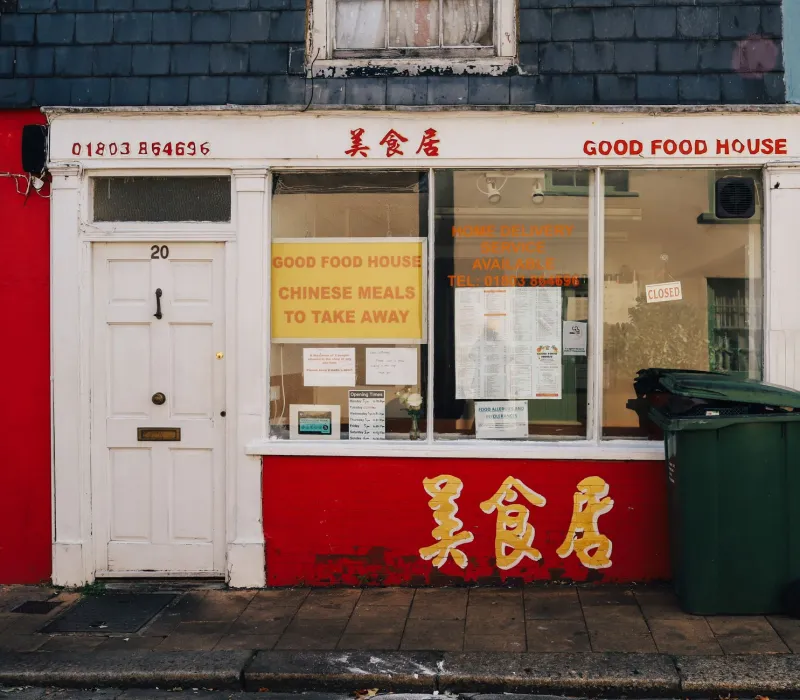
Photo: don cload , CC BY-SA 2.0, via Wikimedia Commons
There is a particular sound a Chinese takeaway makes when it lands on the kitchen counter: the rustle of a paper bag, the clunk of a plastic tub, the faint crinkle of foil. You ordered the same thing as last time. You may even have ordered it from the same place. And yet the vessel in front of you is different again. A wide foil tray where there used to be a deep plastic tub. A square carton instead of a round one. Sauce in a little pot rather than flung over the top.
Packaging is the part of the takeaway nobody puts on the menu. But it shapes how the food travels, how it reheats, how much you get and how much ends up in the bin. It is also a quiet little signature from the kitchen — less romantic than wok hei, more revealing than you might think.
The foil tray: the reliable workhorse
Foil trays are the sturdy uncles of the takeaway world. They hold their shape, stack neatly and take heat well. In a British Chinese takeaway, foil tends to turn up around the drier stuff: salt and pepper chips, ribs, maybe a tray of noodles that needs to stay loose rather than steam itself into a block.
Foil is good at conducting heat, which is why it can go into a domestic oven and crisp up what a plastic tub would only soften. The catch is the lid. A foil tray with a crimped foil lid is not a microwave invitation. If you are reheating, decant into something microwave-safe unless the kitchen has clearly said otherwise. And foil trays are brilliant at hiding a small portion: the wide, shallow format makes a modest amount of food look generous until you tip it out and realise most of the tray was air.
The plastic tub: sauce, rice and the microwave question
The classic Chinese takeaway tub — usually polypropylene, usually with a lid that never quite clicks back on properly — is the workhorse of wet dishes. Curry sauce, chow mein with extra sauce, anything in a glossy gravy. It is light, cheap, leak-resistant enough for a short car journey and, in theory, microwave-safe.
In theory. The trouble is that nobody prints reheating instructions on the lid. You are left squinting at a recycling triangle and making a judgement call. A decent rule for leftovers: transfer to a mug or bowl, cover loosely, heat in short bursts and stir so the middle catches up with the edges. Rice is the one to treat with respect — cool it quickly, fridge it promptly, reheat it once until piping hot, and do not push your luck with a second round.
Plastic tubs also stain. A curry sauce tub will wear its history forever, which is fine if you are reusing it for leftovers and less fine if you are trying to convince yourself it is still a clean kitchen item.
The paper bag and the sauce pot
The paper bag is the stage curtain. It is also a warning. A bag that has gone soft and translucent at the bottom means something has leaked, and it is usually the thing you were most looking forward to. Good takeaways double-bag, or put sauce pots upright in a separate small bag, or wrap the whole lot in a carrier bag with the handles tied.
Those little sauce pots are their own economy. A pot of sweet and sour, a pot of curry sauce, a pot of garlic and chilli — they are a way of keeping a dish from going soggy on the way home. They also let a kitchen charge for something that used to arrive free, which is fair enough until you count the plastic. The sachets are worse: soy, sweet chilli, the tiny vinegar pouch that always splits. Useful, maddening, and almost never recycled properly.
What the packaging quietly says about the kitchen
A takeaway that uses rigid, well-lidded tubs and separates its sauces is usually a takeaway that has thought about the journey. A place that sends everything in thin foil trays with no lid might be cutting costs, or might just know that its food is dry enough not to care. Neither is automatically better. Packaging is a set of trade-offs: cost, heat retention, leakage, stackability, the local council's recycling rules and whatever the cash and carry had in stock on Tuesday.
You can learn a little from it. Deep tubs suggest a generous sauce-to-solid ratio. Wide shallow trays suggest something that needs to stay crisp. A paper bag with the name stamped on it rather than scribbled in biro suggests a kitchen that has invested in its own identity. None of this tells you whether the food is any good. It just tells you what kind of operation you are dealing with.
The recycling postcode problem
Here is the quietly serious bit. Takeaway packaging is a recycling maze in the UK because every council is different. Foil is often recyclable, but usually needs to be clean and scrunched into a ball roughly the size of your fist so it does not fall through the sorting machinery. Plastic tubs are sometimes accepted, sometimes not, and almost always need rinsing. Paper bags soaked in grease are generally not recyclable. Compostable-looking cartons are only compostable in the right facility, which your kerbside collection probably is not.
So the honest advice is dull but useful: check your council's list, rinse what you can, scrunch the foil, and do not wishcycle. Putting something in the recycling bin and hoping is not the same as recycling it.
The portion-size illusion
Packaging also changes how much you think you have eaten. A deep tub of rice looks mean until you tip it out; a wide tray of noodles looks enormous until it settles. This matters when you are ordering for two, or trying to work out whether a "large" is actually large. If you are comparing takeaways on price, compare the filled weight or the number of tubs, not the footprint of the tray. The £2 difference between two places can disappear very quickly when one of them is sending you a tray that is 60 per cent air.
The reheating instructions nobody prints
Since the lid is not going to tell you, here is the short version. Decant into a microwave-safe container. Sprinkle a little water on rice or noodles, cover loosely, and heat in two-minute bursts, stirring between. Reheat until piping hot all the way through, not just warm at the edges. Eat it once. Do not reheat rice twice. And if the dish was dry to begin with — ribs, crispy things, chips — the oven or air fryer will do a far kinder job than the microwave.
The tub you get is not the meal. But it is part of the meal: the thing that carries it home, decides how it survives the journey and sits in your fridge the next day. Next time the bag lands on the counter, have a look at what the kitchen chose. It is a small clue, and a surprisingly useful one.