Sweet Nothing: Why the British Chinese Takeaway Menu Simply Stops
There is a moment, about twenty minutes after the last foil tray has been scraped, when the conversation at a British kitchen table tends to go the same way. Someone says they couldn't eat another thing. Someone else says they might have a look at the pudding menu. And then everyone remembers, at the same time, that there isn't one.
This is not a complaint. It's an observation about a genuinely odd gap in the national repertoire. Indian takeaways don't really do afters either, but at least you can point at the kulfi. The pizza place will happily flog you a tub of Ben & Jerry's for four quid. Even the chippy has a freezer cabinet of ice lollies by the till. The Chinese takeaway, meanwhile, delivers a full savoury arc — crackers, ribs, a main, a rice, a side of chips for the table — and then walks off stage without a word.
The menu that stops dead
Look at a typical takeaway menu, the laminated sort that lives in the kitchen drawer, and you'll notice the architecture. Starters. Soups. Spare ribs and other 'extras'. Chicken dishes. Beef dishes. King prawn dishes. Foo yung, chop suey, curry. Rice and noodles. Then a block of set meals for one, two, four, and a page of sides so long it includes both chips and 'chips with onions'.
And that's the lot. Nothing sweet. The only thing resembling a pudding is the free bag of prawn crackers you didn't ask for, which is technically a starter but functionally a crisp.
Compare that with the dine-in Chinese restaurant, where a dessert page absolutely does exist: banana fritters, pineapple fritters, toffee apple, toffee banana, occasionally a slice of something with cream. Often it arrives with a sparkler for a birthday. So the food isn't missing from Chinese cooking in Britain. It's specifically missing from the takeaway format.
Where did the fritters go?
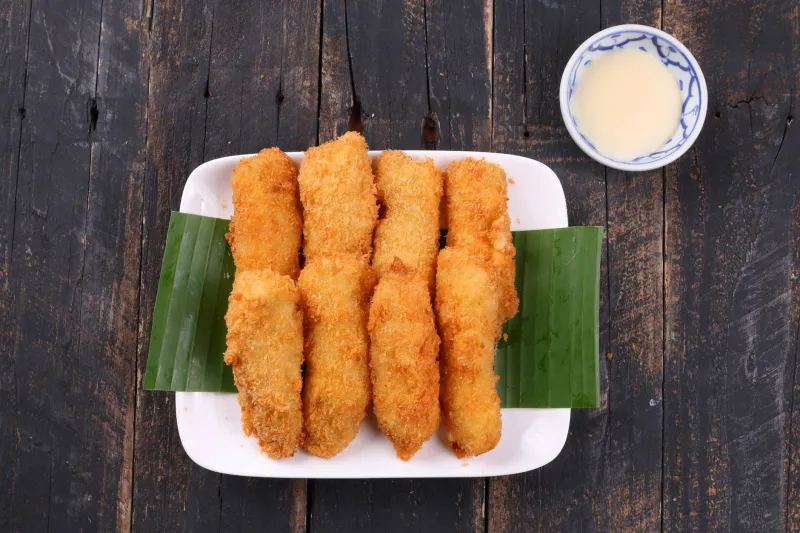
Banana fritters were once a proper staple of the British Chinese menu, back when menus were printed in two colours and everything came with a choice of boiled or fried rice. You'd get battered banana rings, hot from the fryer, with a little jug of golden syrup or honey. Pineapple fritters worked the same way. Some places did a toffee banana that would weld your teeth together for a fortnight.
Ask why they've largely vanished and the answers are practical rather than cultural. A fritter is a live, unstable thing. Battered fruit has a shelf life measured in minutes: seal it in a foil tray and the steam turns the crust to wallpaper paste before the driver reaches the second roundabout. The margins are thin, the prep is fiddly, and the same fryer that turns out salt and pepper chips isn't ideal for something sweet. Most takeaways quietly decided the effort wasn't worth a £3.50 sale that generates complaints.
There's a simpler explanation too. For most households, pudding is already in the freezer or the cupboard. You don't need the takeaway to supply it, and they know that.
The closest thing to a course
So what fills the gap? Three things, and none of them are really dessert.
The fortune cookie is the closest British Chinese takeaway has come to inventing its own finishing ritual — a small, crunchy, faintly cardboard-ish full stop that exists to be cracked open and argued over. Then there's the complimentary orange or the little tub of lychees some places still tuck in with a big order.
And finally the ice cream tub, which is more common than people realise. Plenty of takeaways keep a small freezer of 500ml vanilla, banana or honeycomb tubs and will add one to your order if you ask, in the same way they'll add a bottle of Coke. It's not on the menu, because it isn't really theirs.
What you can still order
If you want to finish properly, here's the practical shortlist.
Banana or pineapple fritters — still out there, mostly at older, sit-down-or-collect places. Order them at the same time as everything else and ask for the syrup on the side. Collect rather than get them delivered, and eat them within ten minutes of the bag hitting your counter.
Toffee banana or toffee apple — rare in takeaway form, much easier to find if the restaurant has tables. It genuinely does not survive a delivery bag, so don't try.
Sesame balls — the dim sum classic, glutinous rice wrapped around red bean paste and rolled in sesame. Available frozen from Chinese supermarkets, and on the menu at any takeaway that does dim sum. They reheat beautifully in an air fryer, which makes them the most takeaway-friendly Chinese pudding there is.
Mango pudding and lychee jelly — chilled, wobbly, sold in tubs at Asian grocers and increasingly offered as an add-on. Ask; you'd be surprised how often the answer is yes.
Fried ice cream — the unicorn. Very few places do it, all of them are worth knowing about.
An egg custard tart from the bakery two doors down — not strictly the takeaway's pudding, but it's on the same parade of shops and it's the move that experienced households make.
Asking without feeling rude
There's an unwritten rule here and it's worth naming: nobody expects you to order pudding, so asking for one can feel like querying the bill at a wedding.
The trick is to fold it into the order rather than bolt it on. 'Do you do banana fritters?' is a normal question and won't offend anyone. If the answer's no, ask whether they've got ice cream tubs — many do. Ring rather than use the app, because the dessert question lives in the gaps of the menu, and the person on the phone knows the gaps better than any website does.
And if the answer is a polite no, don't take it as a slight. Take it as the shape of the thing. The British Chinese takeaway is a savoury institution, built for a full table and a fridge full of leftovers, and it has decided — quietly, over about forty years — that the sweet course is somebody else's job. The Viennetta in the freezer has been waiting all evening. It knew.